
The short answer: A good nail grinder files your dog’s nails down gradually instead of chopping them, which makes it the safer choice for dark nails and nervous dogs. Look for adjustable speed, a quiet motor, an LED light, and a diamond or ceramic grinding head. The five picks below were chosen for those features, clear manufacturer specs, and consistently strong owner feedback.
If you’ve ever nicked the quick with clippers, you know the sound: one sharp yelp, then a kitchen that looks like a crime scene. That’s the whole appeal of nail grinders. Instead of one decisive cut, they sand the nail down a little at a time, which gives you room to stop, check, and adjust. For dogs with dark nails — where you can’t see the quick at all — that margin matters a lot.
That said, not all grinders are worth your money. Some vibrate so hard your dog files a formal complaint; others take forever on a thick Labrador nail. Here’s how to tell the good ones from the shelf clutter.
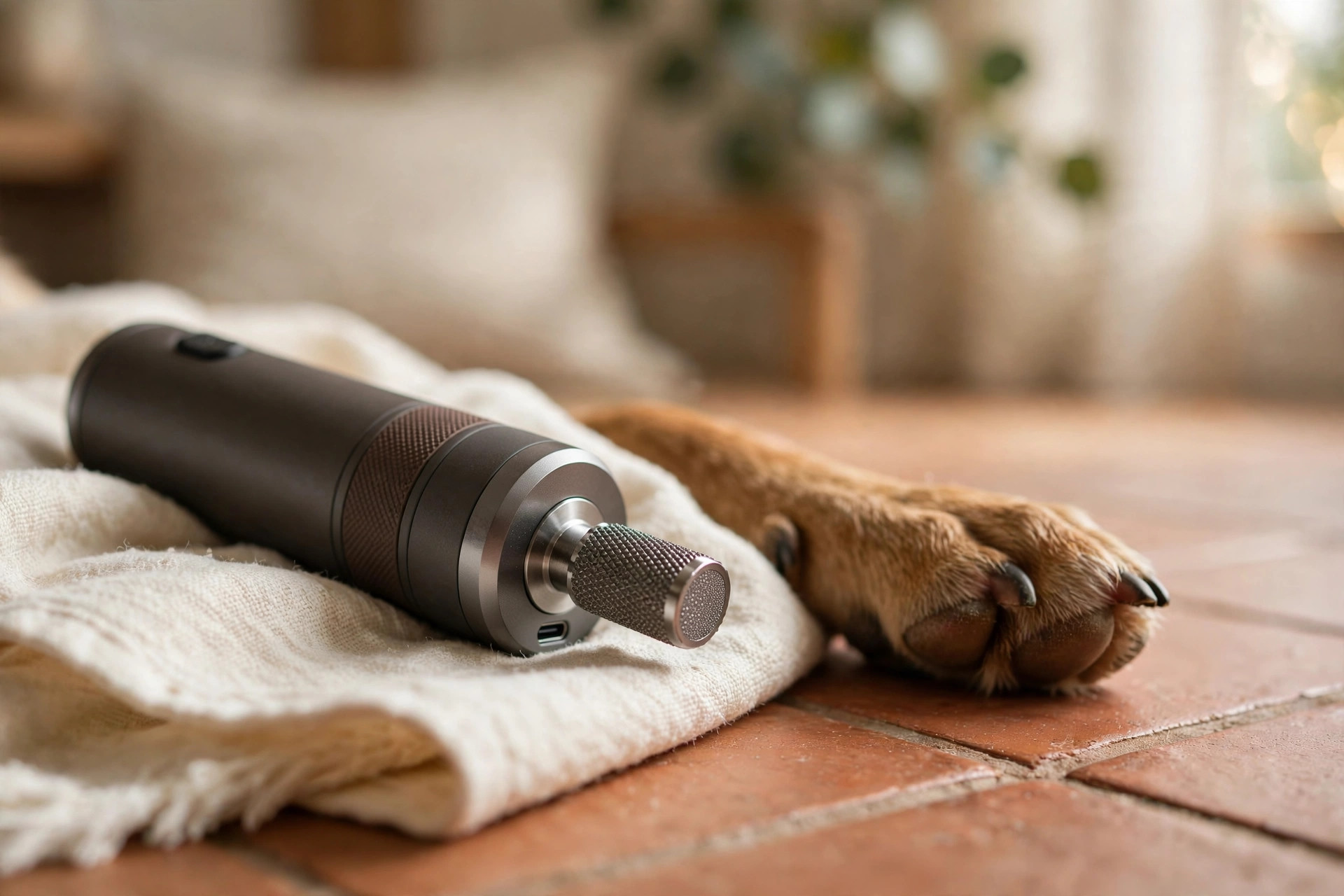
How we picked
We didn’t lab-test these in a facility. Our picks are based on manufacturer spec sheets (speeds, noise ratings, grinding-head material), documented features like LED lights and speed settings, and thousands of verified owner reviews. We paid special attention to reports from owners of noise-sensitive dogs and dogs with dark nails, since those are the two groups a grinder has to win over.
What to look for
- Adjustable speed. A low speed lets you ease a nervous dog in and work small areas; a higher speed gets through thick nails faster. Two speeds is the minimum worth buying.
- A quiet, low-vibration motor. Sound and vibration decide whether your dog tolerates the tool. Whole Dog Journal specifically weighed noise and ease of handling when comparing grinders, and it’s the right priority.
- An LED light. A light aimed at the nail helps you see what you’re doing — and helps you spot the quick on light-colored nails before you reach it.
- Diamond or ceramic grinding head. These materials stay sharp far longer than basic sanding drums, which lose their edge after a handful of uses and turn grooming into a marathon.
- USB rechargeable with decent battery. Grinding sessions are short, but a dead battery mid-paw is annoying. Cordless matters more than you’d think when your dog won’t hold still.
Our 5 picks
Pick 1: Dremel PawControl 7760-PGK — Best overall
What to look for
- Four speed settings for fine control across nail thicknesses
- Replaceable abrasive bands — no dead grinder when the head wears out
- Built-in nail guide to help with positioning
- Detailed manufacturer guidance included
How we evaluate: The spec sheet is what sets this apart: four speeds instead of the usual two, plus replaceable abrasives, which is rare at any price. WebVet selected this model as its best overall grinder on that basis. One caveat from the same review is worth repeating: the nail guide helps with positioning, but it does not detect the quick or automatically prevent over-grinding. The safety still depends on you checking the nail as you go.
Pros
- Real speed control. Four speeds mean you can start low with a nervous dog and step up for thick nails, instead of choosing between “too slow” and “too fast.”
- Replaceable abrasives. Grinding heads wear out; this is the only pick where replacing them is designed in rather than an afterthought. That extends the tool’s working life substantially.
Cons
- Premium price. You’re paying for the brand and the engineering. If you only trim a calm small dog’s nails every few weeks, the cheaper picks below do the job.
Verdict: The most capable, most complete grinder on this list.
Pick 2: Casfuy Professional 2-Speed — Best value
What to look for
- Two speeds (7,000–8,000 RPM, per published specs)
- Diamond grinding head that holds its edge
- LED light on the upgraded model for visibility
- Quiet, low-vibration motor, per manufacturer ratings
How we evaluate: We compare the feature set against the price: diamond bit, two speeds, and an LED light at a mid-range price point is an unusually strong combination. The diamond head addresses the main complaint about budget grinders — sanding drums that go dull after a few sessions.
Pros
- Diamond bit at a budget price. The grinding head is the part that does the work, and a diamond head that stays sharp is the single biggest quality jump in this category.
- Works for cats and dogs. The two-speed range and port sizing suit smaller animals too, so multi-pet households only need one tool.
Cons
- Can warm up with long use. Some owners report the grinding head gets warm after extended grinding — take short breaks between nails, which you should be doing anyway to check your progress.
Verdict: The best balance of price and performance for most households.

Pick 3: LuckyTail Pet Nail Grinder — Quietest
What to look for
- 30–45 dB noise rating, per the manufacturer — among the lowest published figures in this category
- Two LED lights aimed at the nail
- Diamond grinding head for 360-degree grinding
- USB rechargeable, with a stated 4+ hours of runtime
How we evaluate: Noise is the headline spec here, and the published 30–45 dB range is notably low — remembering, of course, that manufacturer testing methods vary. The two LED lights directly address the quick-visibility problem, and the long stated battery life means fewer mid-session charging surprises. Owner reviews from noise-sensitive-dog households are the strongest signal for this pick.
Pros
- Best shot at acceptance by nervous dogs. Low noise plus low vibration is the combination that matters most for sound-sensitive animals — more than speed settings or head material.
- Dual LEDs. Two lights beat one for illuminating the nail from the angle you’re actually working at.
Cons
- Less power for very thick nails. The quiet motor trades off some grinding aggression; owners of large breeds with hard nails may find it slow going compared with the Dremel.
Verdict: The right pick if your dog’s main objection is noise.
Pick 4: VIWIK Nail Grinder with Light — Most versatile
What to look for
- Two speeds (8,000–10,000 RPM, per published specs)
- Two LED lights
- Under 40 dB noise rating, per the manufacturer
- Suitable for small and large animals
How we evaluate: We look at the overlap between speed range and noise rating: 8,000–10,000 RPM with a sub-40 dB rating is a strong combination if the figures hold in real use. The dual-purpose design — marketed for both dogs and cats — suits multi-pet homes, and the LED lights are a genuine help rather than decoration.
Pros
- Speed and quiet in one package. Most quiet grinders are slow; most fast ones are loud. This one attempts both, and the published specs suggest it lands the compromise well.
- One tool for the whole household. Dogs and cats can share it, which matters when you’re buying a tool you’ll use for years.
Cons
- Less proven track record. It’s a newer, less-reviewed name than Casfuy or Dremel, so the long-term durability picture is thinner.
Verdict: A strong all-rounder for multi-pet homes that want speed without the noise.
Pick 5: Casfuy 6-Speed — Most speed settings
What to look for
- Six speed settings for granular control
- Built-in LED light
- Ceramic grinding head, which wears more slowly than standard abrasives
- Quiet operation, per manufacturer ratings
How we evaluate: Six speeds is double the category norm, and the step between settings matters: finer gradations let you find the exact speed a particular dog tolerates. The ceramic head is a durability upgrade over basic sanding drums, per the manufacturer’s material claims. We also note the common owner complaint — heat buildup on long sessions — which applies to nearly every grinder here, not just this one.
Pros
- Fine-grained control. With six speeds, there’s no big jump between “too gentle to work” and “too aggressive for this dog.” That granularity is genuinely useful for anxious animals.
- Durable ceramic head. Ceramic wears more slowly than the sanding drums on cheaper grinders, so the tool stays effective longer.
Cons
- More settings than most people need. Six speeds is great in theory; in practice most owners settle on two favorites and never touch the rest.
Verdict: For the owner who wants maximum control and a long-lasting head.
Grinding safely: respect the quick
Grinding is safer than clipping, not risk-free. The quick — the bundle of blood vessels and nerves inside the nail — is the thing you’re avoiding, and the American Kennel Club’s nail-trimming guidance stresses staying within the nail’s natural curve rather than grinding straight back. On dark nails, where the quick is invisible, grind a little, check the nail surface, and repeat — when a grey or pink oval appears in the center of the cross-section, stop.

Noise, speed settings and replaceable parts are the specs that decide most grooming buys. Our buyer’s guide to choosing pet gear that actually works walks through those checks for every gear category.
FAQ
Are nail grinders better than clippers?
For most owners, yes — grinders remove small amounts gradually, so there’s less risk of cutting the quick, and they leave a smooth rounded edge instead of a sharp cut. Clippers are faster for confident users, but the error cost is higher. If your dog has dark nails, a grinder is the clearly safer choice.
How do I get my dog used to a nail grinder?
Introduce it in stages over several days: first let the dog sniff the turned-off tool, then run it nearby so they hear the sound, then touch the vibrating handle to their paw without grinding, and only then grind one nail. Pair each step with treats. Rushing this process is the most common reason dogs “hate” grinders.
How often should I grind my dog’s nails?
Most dogs need attention every 2–4 weeks. If you can hear clicking on hard floors, the nails are too long. Dogs that walk a lot on pavement naturally wear their nails down and may need less frequent sessions; mostly-indoor dogs need more.
Can grinders overheat and hurt my dog?
The grinding head can get warm during long continuous use, which is why short sessions with pauses between nails are the standard advice. Keep each nail’s contact time to a few seconds, check the nail between passes, and let the head cool if you’re doing all four paws in one sitting.
This article was created with AI assistance and reviewed by our editorial team before publishing.
 5 Best Dog Grooming Clippers for Thick Coats (2026)
 5 Best Cat Grooming Brushes for Longhair Cats (2026)
 How to Choose Pet Gear That Actually Works: The Honest Buyer’s Guide