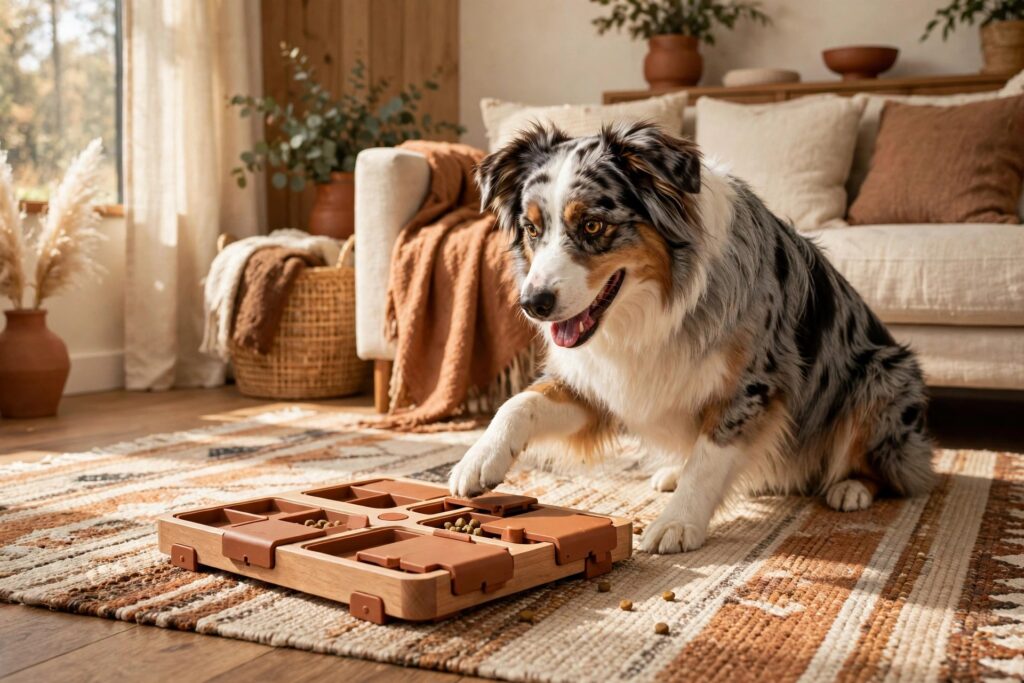
The short answer: the best puzzle toys for dogs who get bored fast are ones that make food harder to reach in stages — sliding compartments, lift-up flaps, stuffable rubber, and sniffing work. Start with an easy win like a lick mat, then move to a multi-step puzzle once your dog solves the first one in minutes.
A bored Australian Shepherd will invent a job. Usually it’s your skirting board. Puzzle toys head that off by giving the dog a problem with a paycheck at the end of it, and they do it in a way a plain chew can’t. The trick is matching difficulty to the dog in front of you. Too easy and it’s a treat dispenser with extra steps. Too hard and the dog walks away — or chews the puzzle itself, which tells you plenty about how that afternoon was going.
What to look for
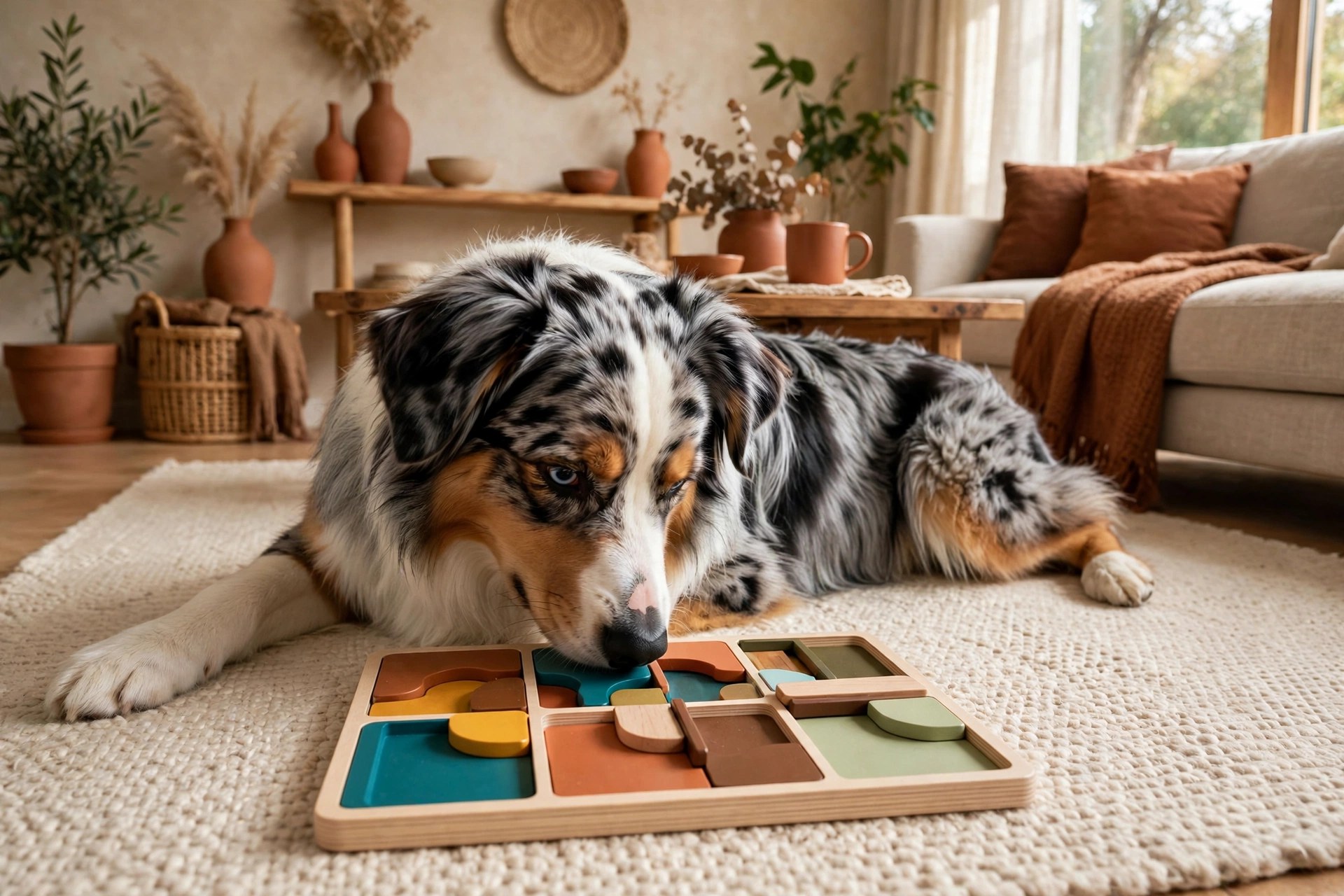
Adjustable difficulty. The toys that earn their shelf space let you make the game harder over time — hide treats in fewer compartments, close more sliders, freeze the filling. A fixed-difficulty toy has a short career with a clever dog.
Materials that survive teeth. Hard plastic sliders, thick rubber, and tightly stitched fabric hold up. Thin plastic hinges and loose felt pieces don’t, and small parts that pop off become a choking worry. If your dog is a determined chewer, puzzle time is supervised time. No exceptions.
Easy cleaning. Anything that holds wet food needs to come apart and go in the dishwasher or wash clean under a tap. A puzzle you dread washing is a puzzle that quietly retires to a cupboard.
The right size. Compartments should suit your dog’s muzzle and paw size. A toy built for a Beagle frustrates a Great Dane, and an oversized puzzle can overwhelm a small dog before they start.
How we evaluate
We judge puzzle toys on four things: how long the challenge stays interesting as the dog learns, whether the difficulty can be raised, how the materials handle chewing and pawing, and how much work cleanup takes. We also weigh who should skip each pick, because the most advanced puzzle on the shelf is the wrong buy for a puppy meeting the concept for the first time.
The 5 picks
1. Sliding compartment puzzle — best first real puzzle
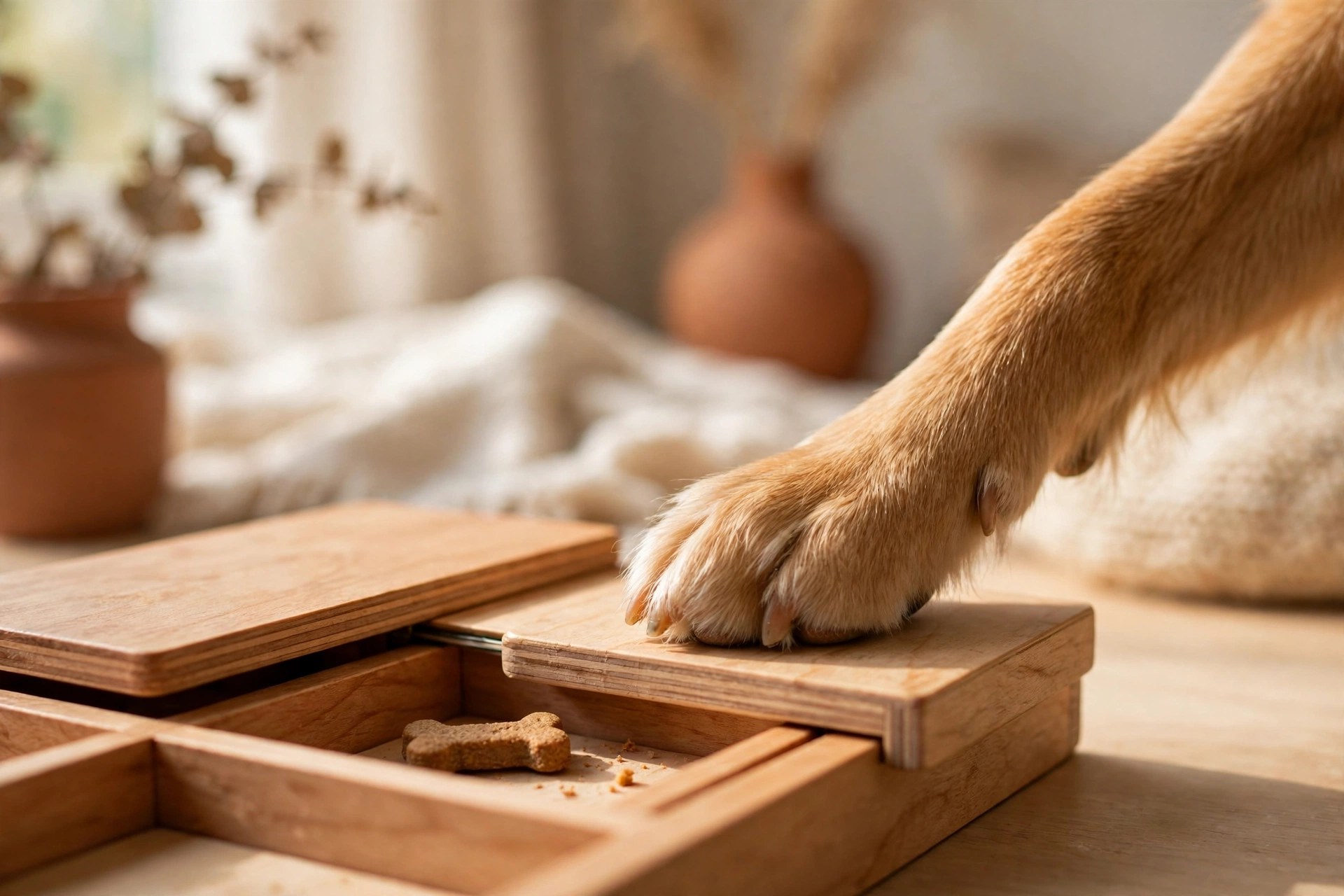
Sliding puzzles in the style of the Nina Ottosson Dog Brick ask a dog to nose and paw compartments open to reach treats underneath. It’s the natural step up from a lick mat: easy to grasp in one session, still engaging weeks later if you load only some of the compartments.
Pros: intuitive for beginners; difficulty rises by hiding treats selectively; sturdy construction. Cons: strong chewers can pry pieces loose, so it needs supervision; a very smart dog may master it quickly.
Best for: puzzle beginners and food-motivated dogs of any size. Skip if: your dog’s first instinct with plastic is to chew it apart.
2. Stuffable rubber toy — best for freezing ahead
The classic stuff-and-freeze design, led by the KONG Classic, isn’t a puzzle in the sliding sense. It’s a slow extraction job. Fill it with your dog’s food and a smear of peanut butter, freeze it overnight, and breakfast becomes twenty quiet minutes instead of ninety seconds.
Pros: dead simple to load; freezing stretches the challenge; the rubber takes serious chewing. Cons: the inside needs a bottle brush or a dishwasher cycle; sizing matters — too small is a safety issue for big jaws.
Best for: crate time, visitors at the door, and dogs who inhale meals. Skip if: you want a toy your dog can use completely unsupervised — no stuffed toy earns that.
3. Lick mat — best for anxious and young dogs
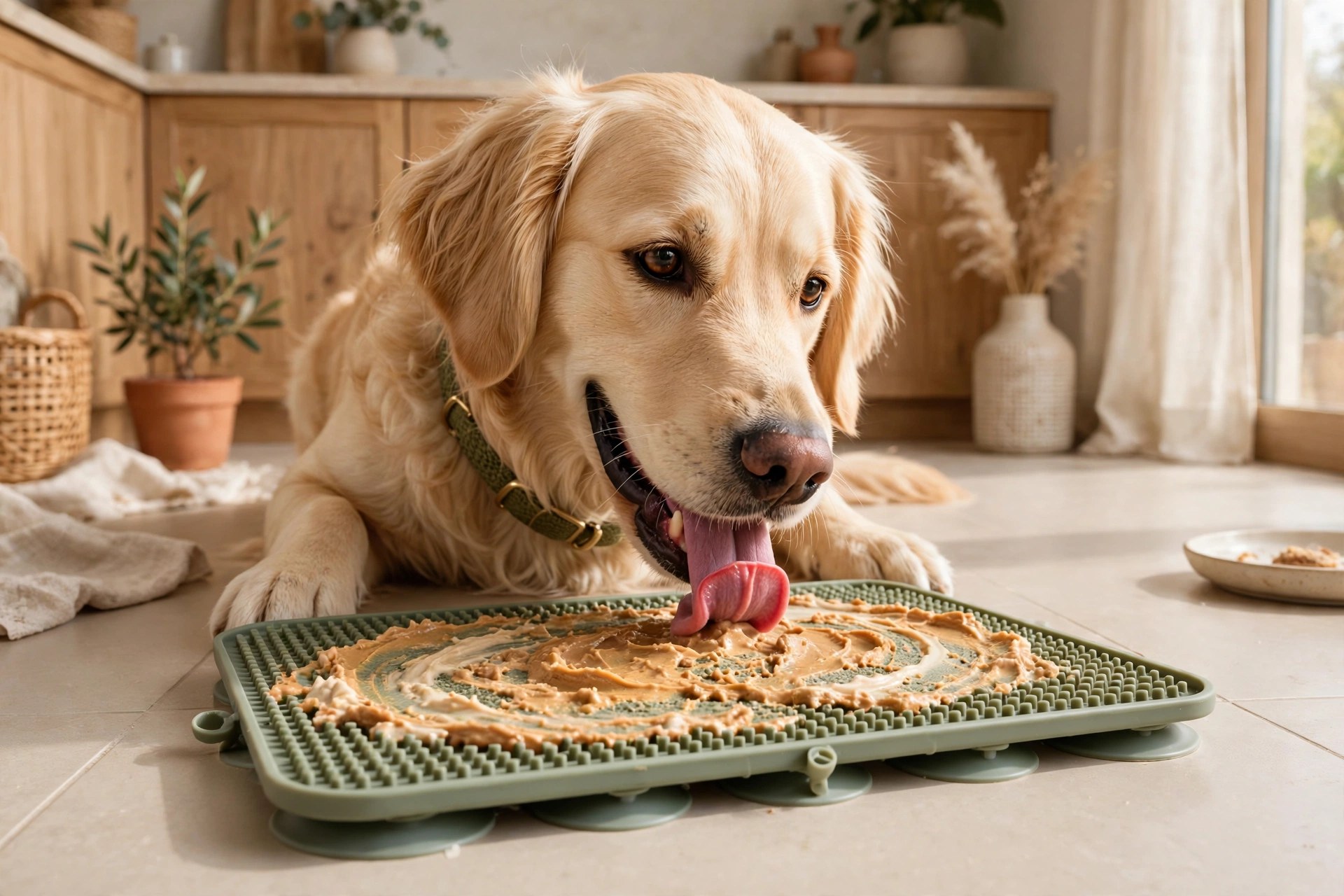
A textured mat spread with soft food asks for patience instead of problem-solving. That’s exactly why it works for puppies, nervous dogs, and bath time. Suction-cup versions stick to smooth floors and tub walls, which keeps the mat from touring the house.
Pros: low frustration; pairs well with grooming and vet-visit distractions; cheap and easy to replace. Cons: determined dogs chew the edges; thin mats wear out fast.
Best for: puppies, anxious dogs, and anyone who needs ten calm minutes. Skip if: your dog shreds soft silicone or rubber on sight.
4. Snuffle mat — best for scent-driven dogs
A snuffle mat hides kibble in a thicket of fabric strips and lets the nose do the work. Scatter a meal through it, ruffle the strips over the top, and watch a hound or herding dog settle into methodical searching. It’s the quietest puzzle on this list and the easiest to store.
Pros: plays to a dog’s strongest sense; slows fast eaters at meals; machine washable versions exist. Cons: fabric won’t survive a dog who digs or tears; shake it out outdoors or it becomes a crumb archive.
Best for: scent-led breeds and rainy-day meals. Skip if: your dog solves fabric by removing it.
5. Multi-step puzzle — best for dogs who beat everything else
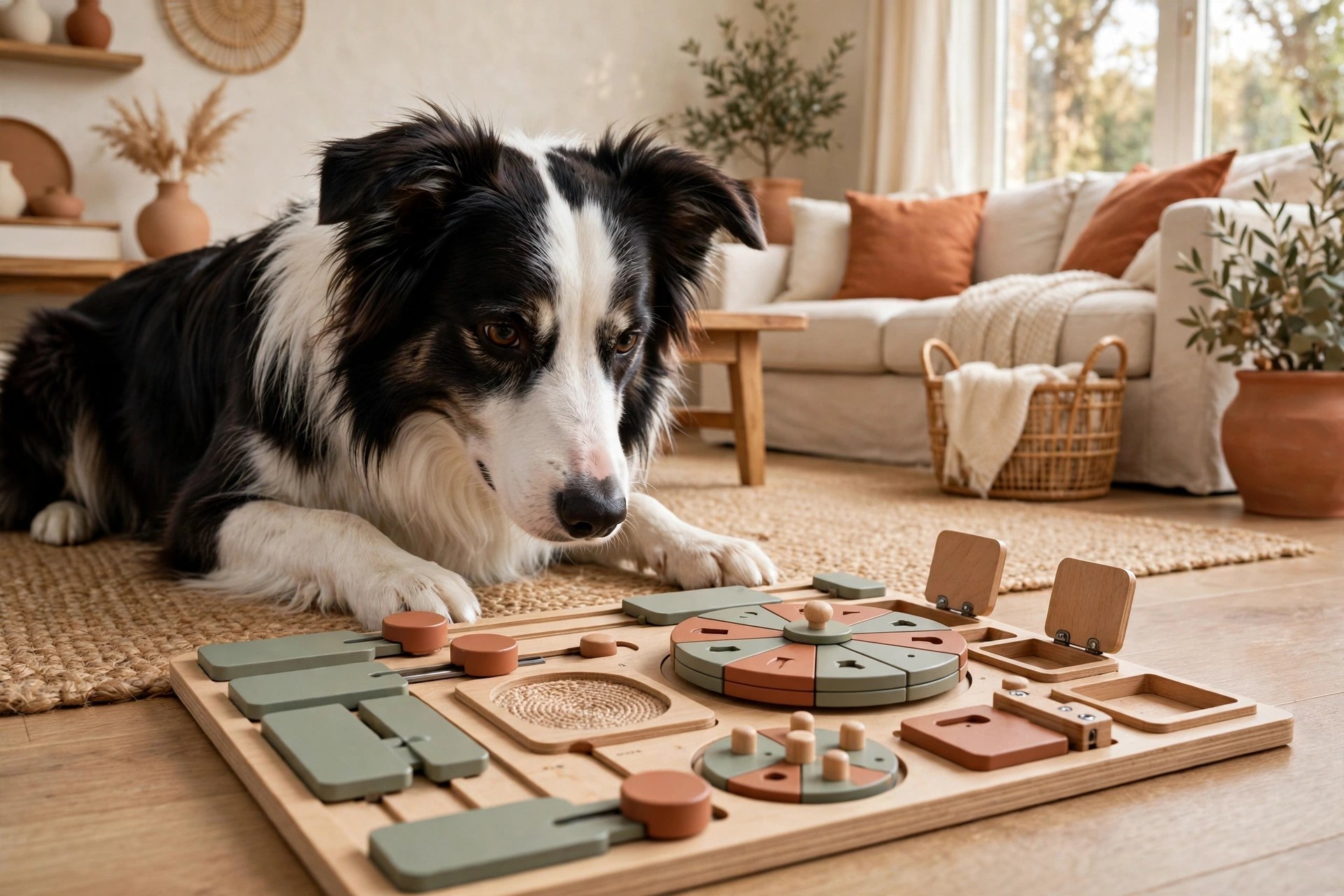
Advanced boards combine sliders, spinning layers and lockable compartments in sequence: one move reveals the next. For the dog who emptied every other pick on this list inside a week, this is where the game continues. Introduce it loaded generously, so the first solve comes quickly and the dog learns the board is worth working on.
Pros: the longest-lasting challenge here; several difficulty stages in one toy. Cons: the most expensive style; small parts demand supervision; overkill for beginners.
Best for: experienced puzzle dogs and high-energy herding breeds. Skip if: your dog is new to puzzles — start at pick one and climb.
Side by side
| Pick | Difficulty | Best moment | Watch out for |
|---|---|---|---|
| Sliding compartment puzzle | Beginner to middle | Daily treat games | Chewing loose parts |
| Stuffable rubber toy | Easy, longer when frozen | Meals and crate time | Correct size for the jaw |
| Lick mat | Easiest | Baths, grooming, nerves | Edge chewing |
| Snuffle mat | Easy to middle | Kibble meals indoors | Digging and tearing |
| Multi-step puzzle | Hardest | Seasoned puzzle dogs | Price and small parts |
Verdict
Buy the sliding compartment puzzle first — it’s the one we’d hand to almost any dog owner. Add a stuffable rubber toy for frozen meals, and keep the multi-step board in reserve for the day your dog starts solving everything before you’ve sat down. Puzzle toys aren’t a substitute for walks, training and company. They’re what fills the gaps between those things, which is precisely when bored dogs get creative at your expense.
Questions owners ask before buying
How long should a puzzle keep my dog busy? For a beginner, five to ten focused minutes is a good session. If a toy is solved in under a minute every time, raise the difficulty. If your dog gives up or gets frustrated, make it easier — the win is what keeps them playing.
Can I leave my dog alone with a puzzle toy? Treat every puzzle as a supervised toy. Pieces can loosen, fabric can tear, and a frustrated dog may chew parts they’d normally leave alone.
Do puzzle toys actually tire dogs out? Mental work is genuinely tiring — searching, problem-solving and licking all ask for concentration. Owners often find a short puzzle session takes the edge off an energetic dog, though it doesn’t replace physical exercise.
What should I put inside? Part of your dog’s regular food is the safest default, so puzzle calories come out of the meal budget rather than adding to it. Small amounts of plain soft food work well for lick mats and stuffable toys.
This article was created with AI assistance and reviewed by our editorial team before publishing.
 How to Choose Pet Gear That Actually Works: The Honest Buyer’s Guide
 7 Best Cat Toys for Indoor Cats (2026)
 Indestructible Dog Toys: 9 Picks for Power Chewers